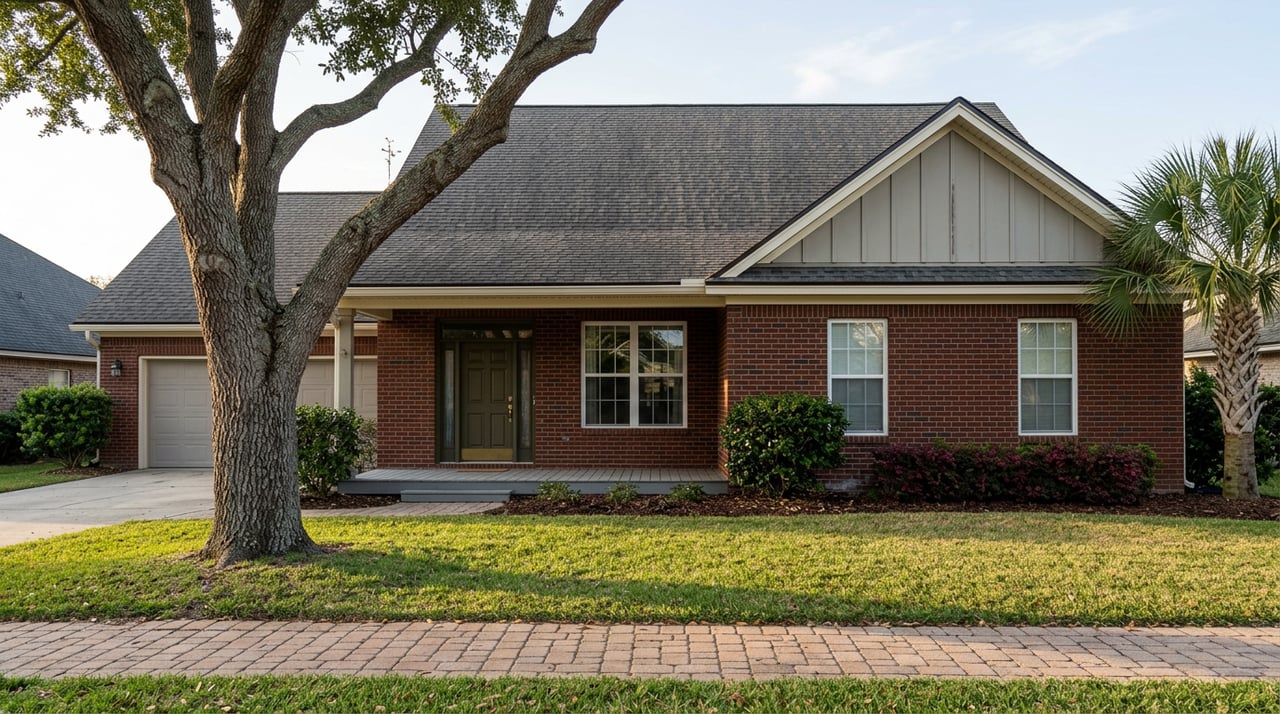
In the spring of 2025, a developer bought a 133-year-old house in East Hill and started pulling it apart before anyone had approved a thing. Someone was on the property removing shutters and doors when a neighbor noticed and flagged it to the Old East Hill Neighborhood Association. Association president Pat Meusel brought it to the city's Architectural Review Board, which was being asked to approve a full demolition so the buyer, a real estate investment company called aDoor Properties, could build two new homes on the lot.
The board said no. One member pointed to the city's Land Development Code, which discourages tearing down historic structures, and the application was also missing a required engineering report. The house stayed standing.
That single meeting is the clearest window into something the median price on any listing portal will never show you: in a large chunk of Pensacola, the seller isn't the only party who decides what happens to a house. A five-member volunteer board does too, and it has said no before.
The Board That Decides What "Historic" Means
Pensacola has four designated historic districts: the original Pensacola Historic District, North Hill, Old East Hill, and the Palafox Historic Business District. Every one of them sits under the review of the city's Architectural Review Board, which signs off on exterior renovations to existing buildings and on the design of any new construction, including demolitions, within district boundaries.
The districts aren't the same age or the same rules. Old East Hill was formally established by city council action in 1992, covering roughly thirty blocks of homes built between 1870 and 1920, more than three hundred structures in all. North Hill's preservation effort is older and more organized: the North Hill Preservation Association was founded in 1972 and formally incorporated in 1974, and the district it protects is now on the National Register of Historic Places, one of the largest residential historic districts in Florida. Each district also carries its own zoning code on city paperwork. An Old East Hill address might be zoned OEHR-2. A North Hill property is PR-1AAA. Palafox storefronts fall under C-2A. These aren't just filing codes. They determine which committee reviews your porch rebuild and how strict that review will be.
This matters before you ever get to a number. A buyer comparing a listing in Old East Hill to one in a non-historic Pensacola subdivision isn't comparing two houses with the same rulebook. One of them comes with a design board attached to the title.
Four Numbers, One Median, Four Different Stories
Ask four different sources what a Pensacola home costs right now and you'll get four different answers, and the gap tells you something useful on its own.
Over the three months ending in May 2026, the median sale price across Pensacola ran about $345,000. By July 2026, another tracker put the median closer to $337,450. A live market snapshot dated August 9, 2026 put it at $330,500. Look at closed sales over the trailing six months through July 2026 instead of a single median line, and the middle half of all those sales actually closed somewhere between $190,000 and $395,000, a spread of more than $200,000 around whatever number gets printed as "the median."
None of these sources are wrong exactly. They're measuring slightly different windows, slightly different data sets, and slightly different corners of a city where the underlying inventory doesn't behave like one market. A citywide median is an average of a Craftsman cottage on a pre-automobile street in Old East Hill and a builder-grade three-bedroom off Nine Mile Road. Averaging those two together produces a number that describes neither.
The Same City, Two Different Markets
Here's where the historic-district effect actually shows up in dollars. Established, historic-adjacent pockets like East Hill and Cordova Park have recently traded in a band running roughly from the $320,000s up past $500,000. A few miles away, Ferry Pass and Bellview, both firmly inside Pensacola and both a reasonable commute to downtown, have traded closer to $240,000 to $360,000. Water-view stretches like East Pensacola Heights along Scenic Highway sit in their own band, roughly $280,000 to $480,000, driven less by district rules than by proximity to the water.
A relocating buyer scanning a national portal for "affordable Pensacola homes" could easily land in either Ferry Pass or the lower end of East Hill's range and see similar sticker prices. What they won't see on the listing card is that one of those purchases comes with an unrestricted right to renovate on their own timeline, and the other comes with a review board, a design guidelines document, and, on rare occasions, a documented history of saying no to demolition requests.
That difference is the actual thesis buried in this market: the citywide median doesn't just blur price, it blurs the amount of control a buyer will have over their own house after closing.
What You're Actually Paying For, or Waiting On
The Architectural Review Board doesn't touch everything. Interior renovations, in general, aren't its concern. What it reviews is what happens on the outside of a contributing structure and what a new building will look like when it goes up in a historic zone. In practice that has meant board minutes covering chimney removals in North Hill, storefront door replacements on Palafox, exterior alterations on Zarragossa Street, and, in Old East Hill's case, a proposal for new construction of a lodging house that needed final sign-off before anyone could break ground.
This review layer isn't new friction invented to slow anyone down. It's the mechanism that has kept these neighborhoods looking the way buyers are willing to pay a premium for. But it does mean a renovation timeline in East Hill or North Hill runs on the board's meeting calendar, not just a contractor's schedule. The city went through a public fight over exactly how far this kind of design control should reach back in 2019, when a proposed overlay district for neighborhoods surrounding East Hill drew enough pushback that the city's Community Redevelopment Agency ultimately excluded the area east of Ninth Avenue and south of Cervantes Street from the new rules, and limited the overlay's reach to new construction and full rebuilds rather than everyday repairs. The compromise tells you something: even inside Pensacola's preservation community, there's real disagreement about how much review is too much.
For a buyer, the practical translation is simple. A century-old home's wiring, plumbing, foundation, and roof drive both its price and its insurability, historic district or not. In a reviewed district, the cost of bringing those systems up to a modern standard has to be planned around the board's process, not just a permit office's.
Before You Write an Offer in a Historic District
- Confirm which of the four districts, if any, the address sits in, and pull the zoning code off the listing sheet rather than assuming from the neighborhood name alone.
- Ask what level of restoration the home has already had. A house needing full restoration, a tastefully updated cottage, and a fully restored Victorian can carry the same square footage and very different price tags.
- Get a straight answer on the condition of wiring, plumbing, the foundation, and the roof before you fall for the porch.
- If your plans include any exterior change or new construction, ask what the board's current turnaround looks like. It moves on its own meeting schedule, not the closing calendar.
- Near the water's edge along Bayou Texar or similar low-lying stretches, confirm the flood factor for the specific address. Historic charm and flood exposure aren't the same conversation, but they often show up on the same street.
A Few Direct Questions
Does the Architectural Review Board review interior work? Generally, no. Its authority covers exterior renovations to existing structures and the design of new construction, including demolitions, within the four historic districts.
Can a buyer or investor actually be denied a permit to tear down an old house? Yes. The board denied exactly that request for a 133-year-old East Hill property in 2025, citing the city's Land Development Code and an incomplete engineering report.
Are North Hill, Old East Hill, and the Pensacola Historic District all governed by the same rules? No. Each district has its own zoning designation and its own history, and North Hill in particular is bound by an additional layer through its designation on the National Register of Historic Places.
The median price on any portal is a starting point, not an answer. If you're weighing a historic-district address against a similarly priced home somewhere else in Pensacola, that comparison deserves a longer conversation than a listing card can give you. The Porcelli Team works this market block by block, including its review boards and their history, and can walk you through what a specific address actually allows before you write an offer. Schedule a Free Consultation whenever you're ready to talk it through.