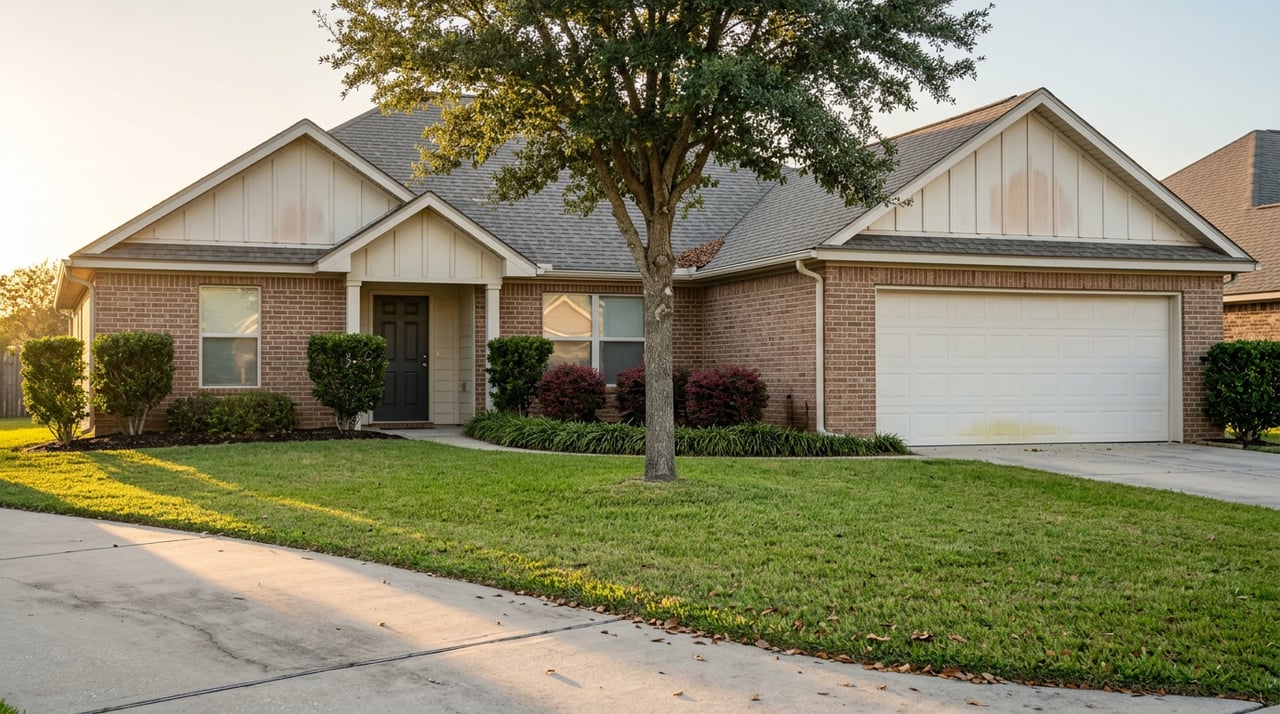
A buyer touring Cantonment can walk through two homes listed within a few thousand dollars of each other and assume they're comparing apples to apples. Same square footage, same era of construction, same commute to Pensacola. What the listing sheet won't tell them is which one sits on a public sewer line and which one depends on a septic tank buried somewhere in the backyard, connected to a private or small community well. That difference doesn't show up in the price. It shows up at closing, and for buyers financing with a VA or FHA loan, it can show up as a delay nobody budgeted for.
Cantonment isn't one uniform utility zone. It's a patchwork, and the seam runs right through neighborhoods that look identical from the street.
Same Zip Code, Two Different Utility Realities
Newer platted subdivisions closer to the Nine Mile Road and Interstate 10 corridor tend to tie into Emerald Coast Utilities Authority's public water and sewer lines. A lot inside one of these developments will typically list that connection outright, because it's a selling point: no tank to maintain, no drain field to protect, no permit history to track down. Move a few miles out toward the more rural stretches of the county, and the picture changes. Larger acreage parcels are frequently marketed as septic-ready, meaning the buyer is expected to install or inherit a private system rather than connect to a municipal main.
In between those two extremes sit older established neighborhoods served not by ECUA at all, but by smaller groundwater utilities like Farm Hill Utilities and Cottage Hill Water Works, which draw directly from the aquifer and serve several thousand residents each. A home on one of these systems isn't on a private well in the strictest sense, but it also isn't on the same infrastructure as a buyer would find in a new build off Highway 29.
None of this is visible from a curb. It's visible in a well and septic disclosure, in a utility bill, or in a call to the county. And it matters more than most buyers expect, because Florida's rules around septic systems are looser than people assume, and mortgage lenders have quietly filled the gap the state left open.
The State Stopped Requiring the Inspection. Lenders Didn't.
Florida used to require a septic evaluation at the point of sale in Escambia County, carried out by the county health department. That changed in 2012, when a new state law prohibited counties from mandating septic inspections tied to a real estate transaction, and Escambia County repealed its local ordinance to comply. Florida still has no statewide requirement that a septic system be inspected before a home changes hands.
That sounds like less friction for sellers. In practice, it shifted the inspection from a mandatory county checkpoint to a private one, and government-backed loans didn't let the requirement disappear. VA and FHA-insured mortgages typically still require evidence that the septic system functions. An appraiser who spots standing water, a sewage odor, or a suspiciously lush patch of lawn over the drain field can flag it, and the lender can require a formal inspection before the loan clears.
The state removed the mandatory inspection in 2012. Two of the most common loan programs used by military buyers effectively reinstated it anyway.
For a buyer on a PCS timeline with a hard move date, that's not a footnote. It's a scheduling risk that has nothing to do with negotiating power and everything to do with what's underground.
What Changed in Escambia County in January 2025
On top of the loan-level requirement, the agency responsible for septic permitting in Escambia County changed hands. As of January 2, 2025, septic permitting authority in Escambia County transferred from the Florida Department of Health to the Florida Department of Environmental Protection, one of 16 Panhandle counties moved to DEP oversight on that date. The underlying rules for how a system gets permitted, repaired, or replaced didn't change. The office you call, and the agency whose records you're requesting, did.
| Before January 2, 2025 | Since January 2, 2025 | |
|---|---|---|
| Permitting authority | Florida Department of Health, Escambia | Florida Department of Environmental Protection, Northwest District |
| Repair permit process | Filed through DOH-Escambia Environmental Health | Filed through DEP Northwest District |
| Underlying statute | Section 381.0065, Florida Statutes | Same statute, same standards |
If you're pulling a permit history on a Cantonment property to confirm when a system was last serviced or repaired, knowing which agency holds the file saves a call or two. That's a small thing until you're trying to close in three weeks and the paperwork is sitting in the wrong inbox.
What a Failed System Costs You, in Time and Dollars
The dollar figures around a septic problem are wide enough that vague reassurance doesn't help anyone. Here's what typically shows up in a Cantonment transaction once a system gets a real look:
- A pre-listing pump-out and inspection, ideally scheduled two to four weeks before a home goes on the market, runs a few hundred dollars and lets a seller fix small problems on their own timeline.
- A cracked baffle caught early might cost around $200 to repair. The same defect found during a buyer's inspection period often becomes a renegotiation point worth $2,000 or more, simply because the leverage has shifted.
- Buried tank lids are one of the most common inspection headaches. If an inspector can't locate and access the tank, they'll either charge extra to dig for it or note "access not available" on the report, which makes buyers nervous regardless of the system's actual condition. Installing risers to bring access points to grade level typically costs $200 to $400.
- A failed drain field is the most expensive outcome. Replacement for a conventional system runs $5,000 to $15,000. For a mound system or an aerobic treatment unit, that range climbs to $12,000 to $30,000.
- If a system does need a new permit, expect $225 to $275 for a repair permit, or $875 to $1,325 for a full new-system permit covering both the site evaluation and construction approval.
- The timeline from first call to an approved operating permit typically runs four to twelve weeks, and stretches longer during the October-through-May building season when permitting offices are busiest.
That last point is the one sellers underestimate. A drain field failure discovered during a 30-day closing window doesn't resolve in 30 days. It resolves in one to three months, which means the closing date either moves or the deal restructures around a repair escrow.
Why This Matters More If You're Financing with a VA or FHA Loan
For a service member relocating on a set timeline, a septic surprise isn't just an inconvenience. It's a collision between a mortgage requirement and a set of orders that don't care about drain field permits. If the appraiser flags the system and the lender wants a formal inspection before clearing the loan, that inspection has to happen, get reported, and in some cases get remedied, all inside whatever window the closing date allows.
The practical takeaway for anyone financing with a VA or FHA loan in Cantonment is to ask the septic question before the offer, not after the appraisal. Request the permit history. Ask whether the property is on ECUA, on a smaller groundwater utility like Farm Hill or Cottage Hill, or on a fully private well and septic system. That single answer changes what due diligence looks like and how much schedule buffer to build in.
The Same Logic Applies Beyond the Yard
The utility line under a Cantonment property isn't the only thing a price tag doesn't reveal. Homes closer to the International Paper mill off Muscogee Road sit near a landmark that's been part of the area's economy for generations, and depending on wind direction, some buyers notice an occasional industrial smell that never shows up in a listing photo. It's a different kind of invisible detail, but the lesson is the same one the septic question teaches: two Cantonment addresses at the same price can carry very different day-to-day realities, and the only way to know which one you're getting is to ask specific, local questions before you're under contract.
What Cantonment Sellers and Buyers Actually Ask
Does Florida require a septic inspection before closing? No. Florida removed that requirement statewide in 2012. A seller isn't obligated to have the system inspected, though most buyers request one as part of their own due diligence.
How do I find out if a Cantonment home is on public sewer or septic? Check the property's water and sewer utility on record, ask whether ECUA services the address, and request the septic permit file from the Florida Department of Environmental Protection's Northwest District if the home has ever had a system installed or repaired.
What if my VA or FHA loan requires a septic inspection the seller didn't plan for? It happens more often than buyers expect. The best move is to build inspection and repair time into the contract timeline from the start, rather than discovering the requirement after the appraisal comes back.
If you're weighing a Cantonment listing, whether you're buying with orders in hand or preparing to sell a home that's been on a private system for twenty years, the details above are exactly the kind of thing a local conversation sorts out faster than a search engine can. The Porcelli Team works through these questions with Cantonment buyers and sellers every week. Schedule a free consultation and let's find out what's actually under the yard before it becomes a surprise at closing.